


Have you ever wondered why some people seem to move past things so effortlessly, while others have a harder time even acknowledging their feelings, let alone processing and letting them go? If you have, I’m writing this for you. From both an anecdotal and scientific perspective.
I used to be close friends with a girl I really admired, particularly for her ability to get over things instantly. While I took days if not weeks to decide how I felt about something (which I now realize is an avoidance tactic), I saw her process things in real time and decide how she felt. What made the difference, especially, is that she acted on those feelings at once. I was so confused at how she was able to do that and questioned if she’d even truly processed the feelings and wasn’t acting impulsively.
I remember a particular instance of us sitting at a park in a sunny Vancouver summer day, discussing our love life and weekend plans. She’d been seeing a guy who was giving mixed signals and so we sat down, shared our perspectives on the situation, and she’d made up her mind and stuck with the decision (sorry I can’t share more details). “What if we’ve wrong” “Then I’ll do something else [redacted]” I was so surprised by her detachment from the outcome, an indication of self-trust. I remember us laughing because I realized then that it’s not that I need more days to feel my feelings; usually it’s that I’m delaying feeling them and taking action.
So here’s my 4-step routine for whenever ambiguous feelings arise:
Naming the feeling
Feeling it in your body
Sitting with that feeling in your body
Taking action (/letting it go)
repeat.
I’ll go through each step (exactly as I’ve written it in my notes app, as a self-reminder)
Naming the feeling. In my first few therapy sessions, I remember my therapist asking me how do I feel. My vocabulary of feelings were limited to about 3 feelings: happy, sad, angry. Come to find out, there’s way more feelings that exist, as well and being able to name them is a great starting place. So let me introduce you to the feelings wheel:
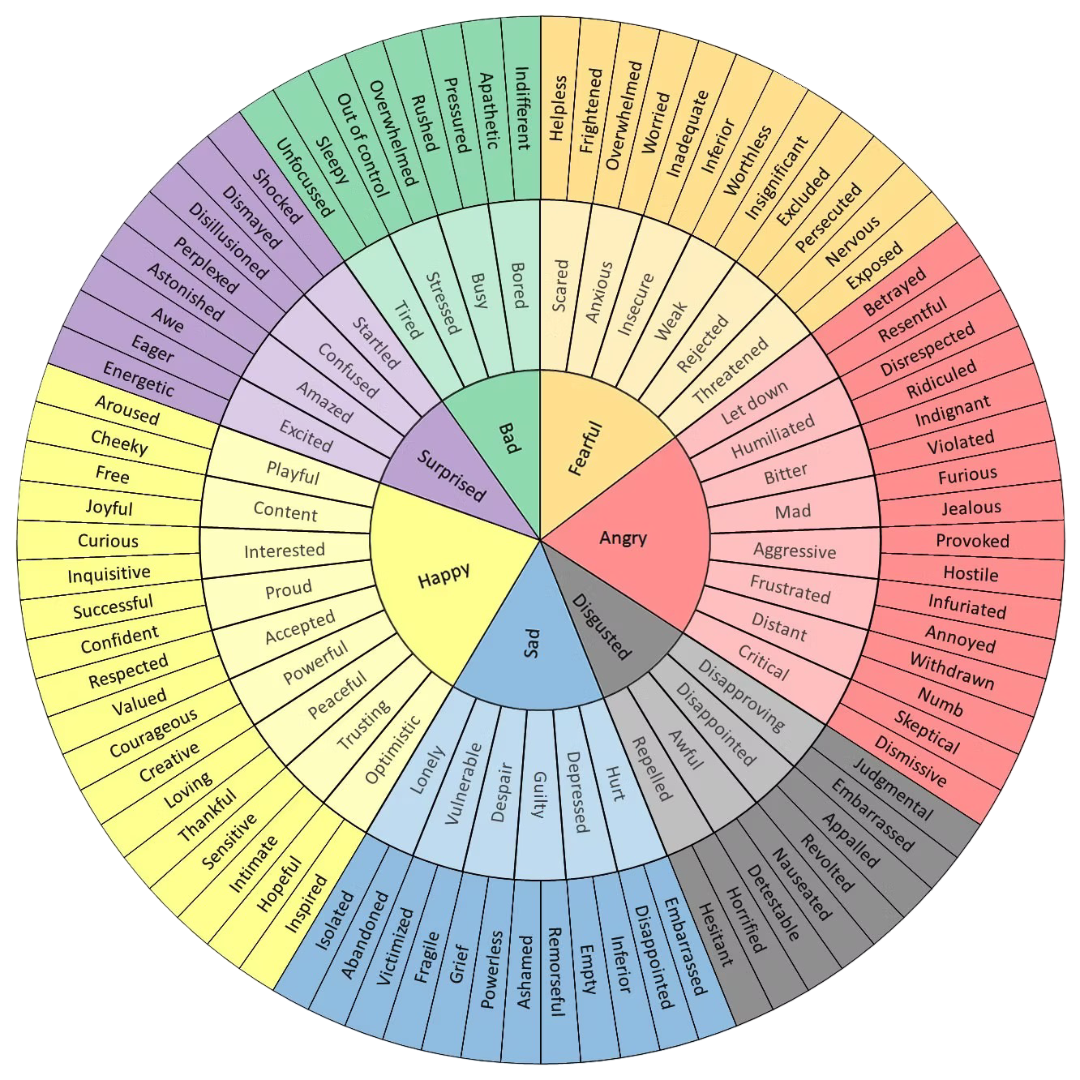
feelings wheel
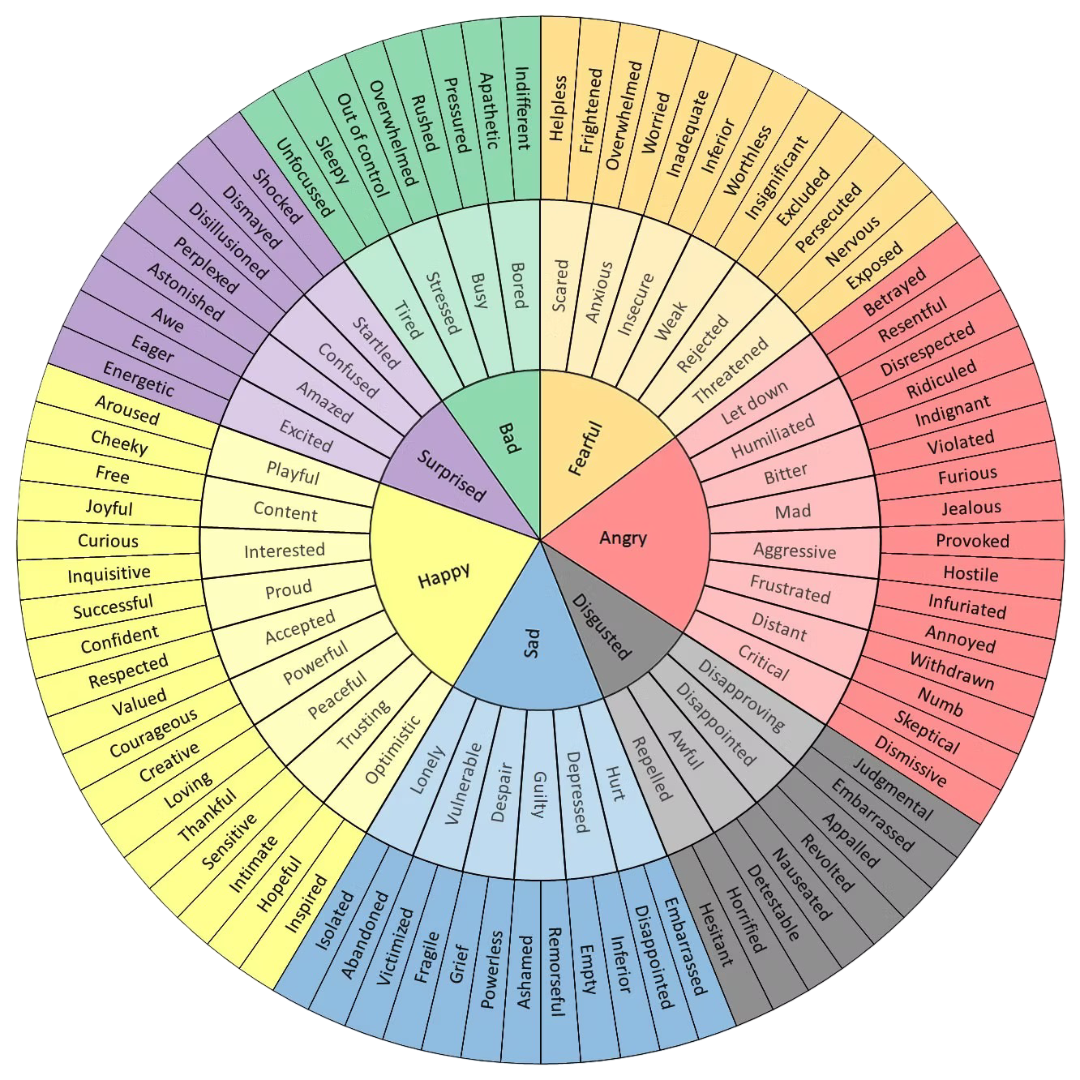
Feeling it within your body. Once you’ve narrowed down your feelings (it can be a mix of them), it’s time to actually feel them, physically. Where exactly in your body do these feelings manifest? For instance, (using the feelings wheel) you might be sad —> hurt —> embarrassed that you made a mistake at work. Now, forget about the feeling itself, and focus on your body’s reaction. Is your chest sinking? Or are you feeling it in your gut? Maybe your arms feel a little heavier? To me this exercise was life-changing because I almost never paid attention to what’s going on in my body. I spent so much time rationalizing, intellectualizing and thinking about the feeling that I forgot my body.
Sitting with that feeling. Because the first few times, it might be a bit uncomfortable (sit with that too).
Taking action. This is my favourite part. So what. You don’t like the dirty looks your co-worker gives you when you walk in. It makes you angry -> aggressive -> hostile. Here are two ways to address this feeling (or not).
avoid taking action: by ruminating on it, asking yourself why so and so happened this way instead of that, constantly feeling sorry about the situation, slowly building resentment. This is an avoidance trap.
take action: by talking to her about it, by deciding genuinely not to care (only if you’re not ruminating, etc…), finding other solutions basically
Repeat as often times/ when other feelings arise!
This is something that takes consistency and conscious effort to become second nature. It’s a habit so it will take time to develop. But it is more productive than overthinking to no avail. Of course the actions will not come without secondary or tertiary feelings; but then you will deal with those as well, same as you have! By developing this habit now, you are also developing more self-trust which will help you in navigating more complex feelings and challenging times.
You might also like:
Fostering inner safety and self-trust

When I was initially diagnosed with c-ptsd and ADHD, I was both validated and confused. I knew I had ADHD, and merely needed a confirmation. But what on earth is c-ptsd? I was nearly triggered and I denied it for the longest time, pretending it had never been part of the conversation.


author’s note:
I promised more light-hearted topics and I hope this will be useful for someone out there. I don’t want to be a self-help guru, but I also don’t want to talk about myself 24/7. I have decided I’ll start putting out some fiction as well, or explore other forms of writing. I hope you enjoy !
Thank you so much for being here. 🕯️💌 - FM
thank you for this. you have no idea how bad i need this. i avoid things a lot by delaying the actions and let my feelings eventually eat me alive. then i resort to self-isolation, bitterness, stress, and so many other negative things. i asked for a sign, so i guess this is it. i have to act on something instead of hiding away in my little corner like i always do. thank you. i will re-read this every time i need to take some actions. have a good day!
Sitting with a feeling feels so counter-intuitive at first because our instinct is to get rid of it. But emotions are energy in motion. To truly release them, we first have to feel them deeply.
Something that has helped me is the 3-minute rule: let your body act out the exact emotion you’re feeling. If it’s anger, scream into a pillow or punch it. If it’s joy, let yourself dance wildly with it.
This gives your body the signal that we’re safe to feel and that you also have the power to release when the time comes. Do you ever do that too?